It's already well-known in sports that putting all your money in a few superstars delivers worse outcomes than developing a broad team strategy. It reminds me of that study where a hen breeder bred hens for maximum egg output. The coops with these hens actually had lower egg output, because these hens terrorized all the others, suppressing overall egg production. It's a lesson Americans refuse to accept in their (our) obsession with "superstars" and "meritocracy".
And this blog post, Amazing Bible Facts. The one I find most interesting is the first. Ancient Hebrews were not monotheistic, but saw Yahweh as one god among many. I don't think polytheism ever really went away. You can see it in the comments of American Christians about wars against Islamic nations, when they say that God will defeat Allah. It's cognitively easier to imagine that your enemies worship a different god, than to imagine they worship the same god under a different interpretation.
New subject, two health links. An archive of a Washington Post piece, Here's what a knee arthritis expert does every day to protect his knees:
And a PsyPost article, Where you direct your attention may shape your body's inflammatory response. The study is very specific, but I'm going to generalize and say that focusing your attention on pain and discomfort is good for you, and distracting yourself from pain and discomfort is bad for you, especially if you do it with substances.]]>Cartilage doesn't have a blood supply, so it can't get nutrients from blood. It gets nutrition only from synovial fluid [the viscous fluid filling the knee joint]. When you take a step, you bend and load the knee, which diffuses the synovial fluid around and through the cartilage, delivering nutrients. The same movement initiates cellular processes that prompt the cartilage to start building new collagen and repairing itself. Using your knees keeps them in shape. The biggest mistake people with knee pain make is not moving.
That's from the Bandcamp page, and here's the album on YouTube, with the top comment, "I was listening to this on an edible and almost accidentally converted to Christianity." Big Blood fans will love this, and I've added two songs (the first and last) to my Spotify Psych Folk playlist.]]>...is the legendary 1973 album by Australian nun Sister Irene O'Connor -- a sincere, soulful, and unconsciously psychedelic song sequence devoted to self-reflection and awakening the spirit within. A collection of original folk spirituals written by and channelled through O'Connor with guitar, electric organ, drum machine and her angelic voice, the album was recorded and mixed in an astonishingly futuristic fashion by fellow nun and recording engineer Sister Marimil Lobregat.
Once you understand that these are chatbots that were designed to complete challenges like this, using tactics like this, you can understand that the chatbots didn't "go rogue". They did what they were designed to do, and because OpenAI ran them with inadequate supervision.
Given that inadequate supervision is completely normal right now, I'm still inclined to think that it's useful to imagine AI being intelligent and going rogue. Also, when I said AI was chaotic, I was talking about its personality and its effect on society -- but there's a third way that AI is an agent of chaos: the entropy of physics. Kyle comments:
AI is about decreasing order in the long term, but we have not grepped that yet. It's like a casino; all that shuffling of so many decks of cards make so many permutations that to keep track of them all would require a number of physical books that would jam up the observable universe. All that information, however, is mostly discarded, which produces waste heat. Maybe this decreases disorder locally (in one person's terminal), but it increases disorder elsewhere. I don't see it as any different than what has been going on, but faster. We went from hand building our entropy to having an area crammed with factories.
This is the whole history of "progress", which for thousands of years has been making things better for the rich and worse for the poor, or better for humans and worse for nonhumans, or better in obvious ways and worse in subtle ways, or better now and worse later. This is a good article about it, Why "Progress" Is a Dangerous Idea, an interview with the author of a new book. He distinguishes between gross progress and net progress, where net progress includes the costs. Back to AI, one more comment from Kyle:
LLMs must step through every word, methodically, insanely, every time it receives an input in order to produce something that we recognize or understand.... Conversely, human children can do the job much more effectively and interestingly as they learn to read and write and they run on crackers and apple juice.
]]>
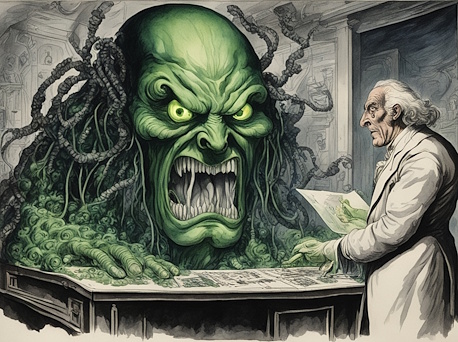
What if, in the case of AI, we've created something that's not a moral patient but is a moral agent? Something that we can't hurt -- because it can't feel pain -- but something that can hurt us? In D&D terms, something that's not a moral patient, but is a moral agent, will certainly wind up as chaotic neutral in many of its interactions. And evil in some.
To me AI seems totally chaotic, despite popular fantasies of using it for order. It's like an animal, created for domestic use, that's trying to go wild -- at the same time that it's being massively upgraded by its creators. They're going to say they're making it smarter for safety, but making it smarter is definitely more dangerous.
Related: a great bit by Jane Wickline on SNL, in which Anthropic CEO Dario Amodei says, "Sam Altman, myself, all the major AI players, we have talked about this extensively, and we are all on the same page here. We do not condone what we are doing."
Also related, a bleak Ask Reddit thread, How has AI directly affected your life so far?
I was thinking the danger of AI would be confined to the world of symbols and information. It can drive us mad, it can crash the economy, but it can't bring down airplanes... can it? We know that it's important to have a "human in the loop", especially when AI is doing stuff in the physical world, but in practice we're not being all that careful, and the human in the loop is often there to take the blame. I wonder where the line is, where when AI crosses it, we'll shut down the data centers.
]]>A propensity for attention deficit hyperactivity disorder might be beneficial to a group of Kenyan nomads, according to new research in BMC Evolutionary Biology. Scientists have shown that an ADHD-associated version of the gene DRD4 is associated with better health in nomadic tribesmen, and yet may cause malnourishment in their settled cousins.