other people's stuff
bookssongs
albums
films
quotes
readings
search this site

Let us send men on a great migration: set free, purged of the commerce-made manners and fat prosperity of America; ragged with the beggar's pride, starving with the crusader's fervor. Better to die of plague on the highroad seeing the angels, than live on iron streets playing checkers with dollars ever and ever.
-Vachel Lindsay, War Bulletin #3 (1909)
May 5. Quick thought on fakery. For years everyone has been saying that when AI images can't be told from real images, there will be lots of fake photos and videos that people take as real. I haven't seen this happen yet in any important way. Making convincing fake imagery is hard, and people who really want to tell the difference will always stay one step ahead.
Anyway, fake images are not necessary. The best tool for deception, now and forever, is words. If you want to fool people, just tell them what they want to hear, with total indifference to reality, and they will come running to join your cult. And now, when those people see real photos and videos that disprove the words, they can just say, "Those must be AI fakes."
Paradoxically, our power over images has made all images weaker, and fake words stronger.
May 4. Doug comments on the quote at the top of this page by Vachel Lindsay:
This is a man who literally walked across America trading poems for bread, and meant every word of it. The War Bulletins were self-published pamphlets he printed and distributed by hand. Pre-internet zine culture, evangelical pamphleteer energy, total outsider operation.
What makes this passage cut deeper than most anti-civ writing is that it's not against anything. It's not burning the iron streets -- it's abandoning them as unworthy of your death. That's a different move. The nihilist says tear it down. Lindsay says it doesn't deserve your attention long enough to tear it down. Walk away. Die somewhere beautiful.
"Ragged with the beggar's pride." The pride isn't despite the raggedness. It is the raggedness. Proof of motion. Proof you didn't trade your hours for upholstery. "Seeing the angels" isn't metaphor-decoration. Lindsay means it. The highroad opens perception that the iron street chemically suppresses. The commerce-made manners aren't just bad aesthetics -- they're a perceptual closing. You literally can't see certain things from inside a managed life.
And four doom threads from Reddit, starting with a tangent from Friday's post: US birth rates just hit another record low, what do you think is the leading cause of this?
Anyone else in US noticed food quality degrading recently and if so what product in what way?
What's a recession indicator that you’ve noticed lately in your everyday life?
What is an industry that is currently on fire (in a bad way) behind the scenes, but the general public hasn't noticed yet?
May 1. For Mayday, a new video of a good political song: Meatraffle - The Wickerman. Usually I prompt the images line by line, but this time I mainly just generated a ton of wickermen. I decided to go square instead of landscape because wickermen are taller than they are wide. Another thing I noticed about this song was that the rhythm didn't vary at all. Sometimes it takes me hours to do the timing, but they must have used some kind of digital metronome because every measure is 4.00 seconds.
Today is Bandcamp Friday. You might want to give a listen to the album Bad Vibes OST by Sexfaces, a D.C. punk band that I went and saw last weekend. It was strange, the entire crowd was old. There were no Gen Z in the whole place. I hope Gen A restarts the cycle of listening to noisier music than their parents. If you like non-noisy music, I want to give another plug to Melissa Kassab.
On a tangent, I saw somewhere that Gen Z is having less sex than any generation in history, and probably also prehistory. It reminds me of the mouse utopia experiment, where mice were given unlimited food in limited space and lost interest in procreating. Modern society is doing something similar, where all measures of quality of life are being ignored except for not dying. "What do you mean you don't want to bring children into this world? The world is better than it's ever been as measured by the number of cures for cancer." If I saw a giant mushroom cloud on the horizon I would probably be relieved that I no longer have to do two factor authentication.
April 29. Some optimism, starting with a great article, The Angine de Poitrine Argument for UBI. That's the name of a trending weird band whose creative contribution would be multiplied by thousands if we had a UBI. If you like their sound, definitely check out Horse Lords. Anyway, the argument also covers Einstein, who did his best work at a slack patent office job, and actual trials of the UBI:
The pattern from Ireland and New York matches the pattern from every saturation basic income pilot we've ever run, going all the way back to Dauphin, Manitoba in the 1970s. When you give everyone in a community a floor of income, entrepreneurship skyrockets. New businesses get started. People take risks they wouldn't have otherwise taken. This isn't surprising. Starting a business is terrifying when the downside is losing your house. It's a lot less terrifying when the downside is falling back on a basic income.
Ireland did not do this because it was a nice thing to do for artists. Ireland did it because art is an enormous economic and cultural engine, and the current system is incredibly wasteful of the people who run that engine. The Irish government calculated a monetary value for art and discovered what should have been obvious: investing in art pays more than it costs. We can apply that same math to everything a basic income unlocks.
The no-go zone paradox: Chornobyl's wildlife thrives amid pro-nuclear shift. I used to be against nuclear power because disasters are inevitable. Now I'm for it because disasters are inevitable, and any place that humans can't go, non-human life does better.
And here in Seattle, Pike Place Market Pedestrianization Pilot Boosts Sales and Visits. They finally closed off cars from driving right through the middle of the market, so of course people would rather go there.
On a tangent, I kind of agree with right wing opposition to renewable energy, not for the reasons they give, which are dumb, but because every time humans get more energy, we use it to make the world worse. I used to think society would collapse from running out of energy. Now I think, if we had magical unlimited energy, society would collapse faster.
April 27. Today I'm in the mood for a rant, starting with this unpopular post from the Seattle subreddit, about draconian anti-theft measures in supermarkets. I agree that supermarkets have to do this because of increasing theft, but I disagree with the comments about the deeper meaning. The Seattle subreddit is full of socially liberal affluent NIMBYs. This is my downvoted comment demolishing all the copium:
I agree, its late stage capitalism. If it's theft by the homeless, why do they have these in midwestern towns with hardly any homeless? If it's general moral decay, why did they not have this in previous decades when violent crime was much higher? If it's left wing economic policies, why did they not have this in the 1950s when the rich were taxed at 90%? If it's soft on crime policies, why are prison populations still so high? If it's anything specific to America, why do they have this in Europe?
People have given up on the social contract, because the ethic of capitalism is every man for himself. Every source of the meaning of life other than money has been wiped away. This is a slow-motion version of what happens in every disaster where people grab everything they can get. The disaster is the death of a culture in which leveraging money into more money is the highest good.
Next, an archive of a good Washington Post article about the rise of Nihilistic Violent Extremism, which prosecutors define as motivated by "a hatred of society at large and a desire to bring about its collapse by sowing indiscriminate chaos, destruction, and social instability."
I'll never understand the right. If society is fucked up, why would you want a strongman leader and uniformed thugs bullying whoever has the lowest status? That's going exactly the wrong direction. But nihilism I get. If society is becoming more and more prison-like, if our public institutions have abandoned the nourishment of human thriving and are only trying to herd us through padded cells until our merciful deaths, then fuck it, let's tear it all down. Let's destroy all fences, all locks, all credentials, all money, nothing but atomized humans coming back together in some new way.
I don't actually support that because, through pure luck, my life is pretty good, and I don't want to starve. I think we have a decent chance at a bumpy transition to a less fucked up world. I'm not going to kill myself, because I don't want to be remembered as having given up. But I can confidently predict a rising tide of both nihilistic extremism and suicide acceptance. You can see it already in this Reddit thread from three weeks ago: At what point does choosing to die become okay?
April 23. This is the best news I've seen this year: Alberta Startup Sells No-Tech Tractors for Half Price. We need this for every technology, but especially in food production, if we don't want the inevitable correction of runaway complexity to starve us all. From the Hacker News thread: "These low-tech tractors could become a hot bed for open source experimentation," and, "How many 3rd parties might be able to bring on upgrades/modifications to a 'dumb' tractor to make it smart vs only being able to buy a 'smart' tractor from one vendor and be forced into its rules/restrictions/price."
Related: Jon sends this inspiring article, Inside Portland's Driftwood Cabins. At the end the author editorializes: "These cabins are not symbols of resilience. They are monuments to lowered expectations, bureaucratic neglect, and a society that has learned to tolerate conditions no decent city should ever accept." Symbols hell, these cabins are resilience, and while we do need more institutional free housing for people who are not capable of building cabins, what we also need is more tolerance for informal responses to the decline of modernity.
April 21. And for the last song on that playlist, I've just finished a new video: John Cooper Clarke - Valley of the Lost Women. This song has my favorite lyrics, and I barely had to deviate from the actual lines to get the AI prompts. I was able to get a few good images from DeepAI, but mostly I used Perchance, which has some pulp styles that really fit this song. As usual, I looked at a ton of images and stayed away from photorealism. I would not say that AI can make art, because it does not have the human experience of making art, but the human experience of art appreciation is indifferent to the source.
April 20. New Spotify playlist, and it's not what you think. 4:20 is a two hour collection of songs between 4:18 and 4:22 in length. It's mainly obscurities and classic rock. I got the idea when I noticed that some of my favorite songs (mainly the last three) are that long, and then I filled it out. This list would be hard to put together if you relied on streaming. All I had to do was go through all my mp3 folders and sort for length.
April 17. New subject: books. Two weeks ago I got two books out of the library, both recommended on the Suggest Me A Book subreddit, both acclaimed novels by middle-aged women. Creation Lake by Rachel Kushner is a great fit on theme: eco-activism, deep ecology, even some cryptozoology. But the writing is so flat that I gave up after 50 pages and wrote on Goodreads that it should be called Exposition Lake.
The other book, Animal by Lisa Taddeo, is a violent psychodrama about how casual infidelity destroys families. That's not in my wheelhouse, but the writing is so good that I kept having to slow down just to marvel at it. This is my Goodreads review.
New subject: AI. A Hacker News thread, with linked article, Stanford report highlights growing disconnect between AI insiders and everyone else. The insiders worship the machine and everyone else is cynical.
April 16. On a tangent from the last post, I think the eventual books by recovered Trumpers will not satisfy me. There are already books by people who have escaped cults. They say they were put in a bubble, where they only saw information that fit the cult's beliefs. People will look back and blame social media, websites designed to maximize clicks by feeding back more of whatever we already think. But it's obvious to me that there's something else going on, something sub-rational.
What I really want, and will not get, is an explanation of charisma. I suppose, in the same way that you can be colorblind or face-blind, I'm charisma blind. Everyone says that JD Vance lacks Trump's charisma, but all I see are different personalities and no glow from either one. Also, what's the deal with Michael Jackson? In terms of record sales and airplay, he was on about the same level as Hall and Oates. Why didn't people get all culty about Hall and Oates in the same way? Was it the moonwalk? Will science discover that certain people are able to modulate their voice at 613.5 Hz which resonates with the temporal lobe to induce a suggestible trance state? I doubt it. It's more like the physical world is an illusion and waves are surging on the level of pure mind.
April 14. Long Reddit thread about Trump as the Antichrist. I have relatives who are devout Catholics, and decent people, who are now deciding whether to support the most flagrantly immoral person in the world against the Pope. It's so weird. Someday when this is over, I hope some recovered Trumpers write books and explain what was going on in their heads, because I don't get it. I tend to see it as an act of sorcery, a magic spell that operates on levels unrecognized by science.
But I do have a theory, and it's based on a counter-intuitive observation of who does not see Trump as the Antichrist: Biblical literalists. To me the Bible is an interesting book with some good stuff and some dumb stuff. I don't think that anything is true just because it's in there. Trump is the Antichrist in a metaphorical or allegorical sense, or at most archetypal. The author of Revelations was not God but a talented human who tuned in so deeply to human wickedness that he had some uncannily accurate hits on how it would manifest thousands of years in the future. Jesus is not going to return in any kind of obvious way, but maybe humans in general will become more Jesus-like, and the Kingdom of Heaven is a potential human society that embodies the Beatitudes.
Fundamentalists don't know how to think this way, and this incapacity is not normal religious thinking -- it's unusual. This article, The Great Myths 11: Biblical Literalism, explains how ancient and medieval thinkers were perfectly capable of seeing religious texts as allegory. Modern humans have acquired a cognitive weakness, I don't know how, that makes them highly susceptible to absolutism. That's how Trump gets his followers, by performing a primal confidence that is irresistible to people with flattened cognition. There's something about his way of being that they get pulled into and can't get out of. It reminds me of a line from Genesis -- not the book but the band: "Look into my mouth he cries. And all the children lost down many paths, I bet my life you'll walk inside."
April 10. Yesterday I finished a project that I've been putting off for years, a page about my Spirit Island stuff. Spirit Island is my favorite board game, a cooperative strategy game where you play nature spirits battling colonists. Back in 2021 I made a set of custom reminder tokens to keep track of multi-spirit solo games, and every winter since then I've been testing and refining three custom spirits. This week I finally put it all together into a video: Three spirit solo game. I don't know how prolific YouTubers do it. This hour-long video took me at least fifty hours of rehearsal and repeated takes. I recorded and deleted entire games just to figure out how to talk about what I was doing, and it's still pretty sloppy. Also on that page are short descriptions of the spirits, and downloads of printer-ready images for the boards and cards.
April 8. It finally happened. The DeepAI Olde Model that I was using for my videos, has been quietly enshittified/upgraded. Right away I saw that something was off, and when I tested familiar prompts in familiar styles, the results were a lot faster, a lot different, and a lot worse. I knew it was too good to last, and now I have to see if I can find any beauty at all in the new machine.
April 7. New playlist! When I was making my two Spotify covers playlists, some of the best songs were not on Spotify. These songs served as the anchor for a YouTube Covers playlist, that I filled out with some of my favorites from the other two lists. They're mostly obscure, with more songs under a thousand views than over a million. There are three covers of Bob Dylan, two of The Rolling Stones and surprisingly two of Van Halen. I love the transition between two not-on-Spotifys, Larkin Poe's Southern Cross and Killdozer's Sweet Home Alabama, which have almost the same riff.
April 1. No ideas this week, but I've just posted my Goodreads review of Paul Kingsnorth's Against The Machine. To give it less than four stars would be infighting, but there's a lot of stuff in it that I disagree with, and I list some anti-machine books that I liked better: Saving The Appearances by Owen Barfield, In The Absence Of The Sacred by Jerry Mander, Tools For Conviviality by Ivan Illich, The Reenchantment of the World by Morris Berman, The Final Empire by William Kotke, and Hospicing Modernity by Vanessa Machado de Oliveira.
Also, this is a great bit from an incredible book that I still haven't finished, James Dickey's Alnilam, describing what we might call the "flow" state, in terms of the swinging of a monkey:
Whatever the gibbon has got hold of is already something else; it's the next thing he's going to have hold of. The present thing is not being replaced by the next thing he's going to catch; it already is the next thing, and the next thing after that is already coming into place, coming at him, coming to him. There's no way that it can't come, or that he would miss it. His catching it is not only built into his body and his rhythm, but it's built into the branch or the limb or the part of a wall that he takes into the rhythm. His whole environment gives itself to him in the rhythm, it flows around him, everything is linked, everything is together for him, and is part of his motion, it's all flow and it's all him, as long as he keeps it up.
March 27. Stray links, starting with a comment from the technology subreddit about AI in business. From the final paragraph:
AI is only reliably used if the outputs can be vetted. This means any user of AI needs to be more knowledgeable and experienced than the work being asked. The user needs to know the correct answer before AI is asked the question. Anything less than this is use through ignorance. When placed into any business environment, ignorance only does harm. That ignorance will destroy a business. And as these high experience, very knowledgeable people retire out of the work force, no one will be there to replace them. The loop closes, and all that's left is complete and total ignorance full-circle.
Two fun Ask Reddit threads, What's something you're pretty sure only you do? And People do the least amount of work as possible at their job, how do you get away with it?
And Matt sends this article with a cool idea: An Age-Based U.S. House Ends Gerrymandering Once and for All:
Just as now, each state would receive a number of representatives based on its population -- but everything after that would change. States would divide their voters into state-wide, age-based voting blocs of equal number, and each of which would elect a representative to Congress. Representatives need not themselves come from the age group they represent; we would leave it to voters to determine who best represents their interests.
March 24. Today I want to compare Donald Trump to George Washington, but first I have to start with the obvious difference. Washington had a popular mandate to be dictator for life. Instead he stepped down and let someone else be president, thus proving to the world that a constitutional republic can actually work. What Trump is trying to prove is that it can't actually work. The leaders of the Republican party believe that the republic was a failed experiment and now it's glorious authoritarianism forever.
But where Trump is like Washington is that they're both good at losing. As a general, Washington lost a lot of battles while taking few material losses. Trump declared bankruptcy a bunch of times while remaining a billionaire. They both knew when to cut and run, and Trump has consistently backed down when he recognized a stronger opponent. Europe showed enough strength that he backed off from Greenland. Minneapolis showed enough strength that he backed off from war on the cities. We'll see what happens with Iran, and if I were to imagine how WWIII would probably start, this is it. And yet, I feel like Trump is just teasing us with Armageddon.
But if not now, when? All the cards are lined up. If we don't get an epic global war in the next year or two, I don't think we'll ever get one again. Never mind winning, what nation can even conduct the kind of mobilization that multiple nations did in WWII? If Trump and Putin and Netanyahu aren't going to go nuclear, who in Gen Z is going to push the buh-ann? I think the most likely scenario is a long muddle of regional wars, civil wars, asymmetric wars, culture wars, and ever smaller genocides as races blur, nations splinter, and the industrial infrastructure decays.
March 20. One more Hacker News thread, Warranty Void If Regenerated, about a fiction story written by Claude with heavy human assistance -- or you could say written by a human with heavy Claude assistance.
I'm enjoying the unfolding of AI. In many ways it's a trainwreck, but it's also a fun learning process. In the last five years we've gone from "Wow, maybe AI can write better than humans" to "No, it's worse than humans in specific ways" to "Any whiff of AI and your writing is condemned," to where we are in this thread, thinking about what it means to make something, shifting from "either you made it or you didn't" to a continuum, where the more of something you put into it, the more you can be said to have made it. I think that thing is choices. For text, there are choices about how to configure the AI, how to prompt it, and then when you get the words, there are choices about whether to use them, or try again, or rewrite them as a human.
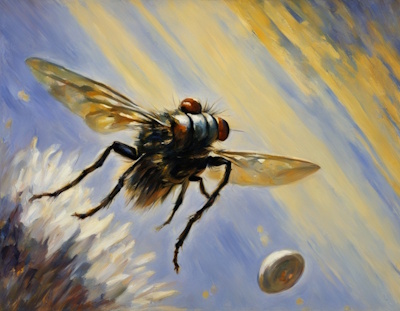
I've "made" another AI video, and my motivation is not to score points without doing anything -- my motivation is the actual doing of the thing. I love the process of trying to squeeze beauty from a machine, learning the ins and outs of image styles, testing prompts and anticipating whether I'll get another lame image or a good one. I love judging images, putting them in the right order to fit the song, and going back to the well to fill in the blanks. One run of images in this video came from a happy accident in a previous video, when I put in the lyric "fly off in a spaceship" and got a mutant house fly (shown above). This time I used that trick to aim for surreal hybrids between insects and airplanes, and pulled up about 50 to find seven that were good enough.
The song was released as a single in 1979 and peaked at number 34. I was there and missed it, and only discovered it recently. This is one of the best written songs of all time: John Stewart - Lost Her in the Sun
March 17. Four Hacker News threads with linked articles. Elon Musk pushes out more xAI founders as AI coding effort falters. The thread has a lot of Musk bashing, but it also has optimism, in that being philosophically out of touch has consequences. The top comment is about how xAI can't attract top talent, and this is from a comment farther down:
I've heard the haha-but-serious joke numerous times that you can't have a security department that's not trans and furry friendly. Thing is, I completely believe that. Those groups are disproportionately represented among the security community, and I personally would not work somewhere that my friends in those groups would feel unwelcome. That's a quite common sentiment even among us straight cis non-furry men.
Polymarket gamblers threaten to kill me over Iran missile story. People are gambling on public events and threatening journalists who report it the wrong way. This is part of the endgame of capitalism, a culture in which the most sacred freedom is the freedom to turn money into more money, where money is a fungible token of power over others.
Stop Sloppypasta, a really well written article about the cognitive labor created by AI text: "Previously, effort to read was balanced by the effort to write. Now LLMs make writing 'free' and increase the effort to read due to additional verification burden."
And something good: Wired headphone sales are exploding. The thread is about people noticing that many high-tech conveniences actually make stuff harder. Related: from my readings folder, Ivan Illich on Cars.
March 13. Two ecology pieces from the BBC, Ancient hedge laying used to boost biodiversity, and Beaver 'engineers' released to create wetlands.
Related, a New Yorker article, Is the Rat War Over? It's mostly about rat personality and culture.
I'm reading more books this year, and this is my Goodreads review of The Wall by Marlen Haushofer:
This book is like Earth Abides, a slow-paced post-apocalypse classic. It's like Hatchet, with a single character surviving with no help from civilization. It's like My Side Of The Mountain in that solo survival turns out to include relationships with animals. It's like Walden, with deep ruminations on the mental state of being closer to nature. And while it's not technically an example, it totally anticipates the ______ genre.
But the book it reminds me of the most is The Curve of Time by M. Wylie Blanchet. They were written about the same time, both of them about independent middle-aged women living on the fringes, facing challenges, and getting you hypnotically into their mind space. I understand why people think this is boring. There are a lot of descriptions of scything hay and moving cows around. But you have to read that stuff to slow your head down enough to understand what this book is doing.
Also, I disagree that this is dystopian. A dystopia is a bad human society, and this book contains no human society whatsoever, except memories of our own dystopia which no longer exists.
March 9. Three stray links. How the "Kill Line" Redefined the American Dream in China, about the Chinese finding out how fucked up America is. "Perhaps most incomprehensible to the Chinese observer is the 'welfare cliff'. In China, social safety nets are generally perceived as a staircase: as you earn more, you contribute more, but basic protections remain. In contrast, the American system often functions like a trapdoor."
Thanks Christopher for this one: In Vermont, one man is bringing pay phones back to life. He sets them up to use the cell network for free, and pays the costs himself. There's no reason towns everywhere couldn't do this, except that our public institutions are ossified and everyone has given up.
And a great Reddit thread that was removed for having a poorly worded question that was probably written by a bot. But the answers contain a lot of interesting stories about kids who are smart in unusual ways.
July 31, 2025. My novel, The Days of Tansy Capstone, is now in beta. I'm good at worldbuilding and bad at exposition, so I want to do more polishing to make it readable, and you should probably wait. But I'm satisfied that I've done what I set out to do: write the novel I wanted to read, that nobody else was writing.