other people's stuff
bookssongs
albums
films
quotes
readings
search this site

Now that everything is wasted
We crush it with our mighty sneakers
We wipe off the corner of our mouth
Before we finally look up and out
-Melissa Kassab, Summer's Over
February 16. AI links, starting with a scary Hacker News thread, An AI agent published a hit piece on me. From the top comment: "The AI companies have now unleashed stochastic chaos on the entire open source ecosystem. They are 'just releasing models', and individuals are playing out all possible use cases, good and bad, at once."
I've written before that one thing AI might do, that I would be excited about, is video game worlds that are as creative as human-made worlds, but with no edges. That's looking unlikely: AI can't make good video game worlds yet, and it might never be able to.
Last year I mentioned a severe AI personality called Absolute Mode. That's Keith's blog post on it, and this is his latest post about wrangling with ChatGPT to actually do it. What I think I understand, is that it is possible, but somewhat difficult, to give an AI a custom personality. If so, this is going to be huge. I mean the whole bubble might pop any day, but if not, someone is going to make a lot of money from slicing and packaging chatbot personalities for mass consumption. Give me a sassy bitch. Give me a Klingon. Give me a golden retriever. Or maybe we won't go down that road because too many people want to talk to a cult leader.
Isn't it funny how talking computers turned out? In old-time sci-fi, they're rational, robotic, precise, and never wrong. Instead, they're like goofy sidekicks, offering encouragement and ideas, but clumsy and unreliable. We thought we were getting the Professor and we got Gilligan.
February 13. Today, 2025 films. There were two sprawling political thrillers, both technically well made by respected writer-directors. Paul Thomas Anderson's One Battle After Another grossed over 200 million, got rave reviews, and will probably win Best Picture. It is Hollywood bullshit. Ari Aster's Eddington grossed under 14 million, got middling reviews, and no Oscar nominations. It was the best film of the year.
Sean Penn will probably win best supporting actor for playing the villainous Colonel Lockjaw, and it really is great acting. But that character, like every character in One Battle After Another, is a cartoon with zero moral complexity. Meanwhile, Joaquin Phoenix in Eddington, and Jesse Plemons in Bugonia, got snubbed for awards by playing complex and fully human red tribe characters.
I'm avoiding the words right and left, but Eddington gave me a sense of how a person might be tagged as "right" for finding what passes for the "left" unbearable: cringey teens and politicians who are tools of big money. Also, Eddington is tagged as a satire, but what I see is authenticity. Reality itself is absurd, especially political reality, and any work of fiction that shows it accurately will seem satirical, while any work of fiction that plays it completely seriously will be propaganda.
Some other 2025 films. Most overrated: Frankenstein, which is flat out just a superhero movie, with great set design, total bullshit dialogue, and they even gave the monster super powers. Most underrated: Rabbit Trap, 4.8 on IMDB but it's a solid 7, a weird horror/art film about fairyland. Most enjoyable: Companion, a comedy thriller about a weaponized sexbot. Least enjoyable: Marty Supreme, in which Timothee Chalamet plays the most unlikeable protagonist of all time -- even Jake Gyllenhaal in Nightcrawler was admirable for being cool-headed. Best horror film and second best film of the year: Bring Her Back.
February 11. Not in the mood to post this week. Three Reddit links: What's a book that you feel encapsulates your soul and why?
Couples of Reddit, what's the dumbest 'house rule' you and your partner made as a joke but now both of you are low-key aggressively serious about enforcing?
What weird skill did you accidentally become good at because of a bad job, hobby, or situation?
February 7. One more link on the below subject, a PsyPost article on cognitive debt:
Electroencephalography (EEG) monitoring revealed that participants in the ChatGPT group showed substantially lower brain activation in networks typically engaged during cognitive tasks. The brain was simply doing less work. More alerting was the finding that this "weaker neural connectivity" persisted even when these participants switched to writing essays without AI.
February 6. Some links about technology and human cognition. Outsourcing thinking is a Hacker News thread with a linked blog post, a careful analysis of the many ways that our own thinking is compromised, if we let LLMs do our thinking for us.
Wirth's Revenge is another Hacker News thread with a linked blog post, this one about programming, and how exactly AI is good and bad at it. From the post: "LLMs don't do reliable, they don't do repeatable.... You don't ask the LLM to perform a repetitive and precise task, you ask it to build a script that performs that task. Except in rare cases, this script does not itself use LLMs."
An archive of a piece from the Atlantic, The Film Students Who Can No Longer Sit Through Films
A deleted Reddit comment, with a long thread below it, about the vanishing middle among grade school students, how there are a few who are really smart because their parents got them reading at a young age, and then a whole bunch who are functionally illiterate because their parents parked them in front of screens.
Also from Reddit, an explanation of P = NP. Basically, even though we can't prove it, we know that P does not equal NP, because coming up with a solution is in a different mind space than figuring out whether a solution is correct, and the more complex the problem, the greater the difference. There's a long comment thread including some stuff about teaching, and how someone who is naturally good at something is the worst teacher, because they can't get in the mind space of someone who finds it difficult.
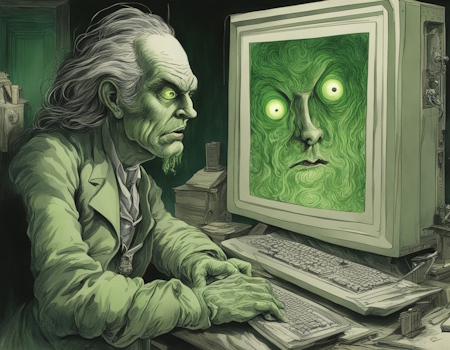
For me, the difference between finding a solution, and recognizing a solution, bears directly on AI images. If I want a good image on a given theme, it's much easier to have an AI generate a bunch of images and pick the best one (the below image was picked out of about 40) than it is to actually draw an image that's that good. So I save a lot of work, but by taking that road, I am failing to gain an understanding of how to draw. Life is short, and I'd rather not know how to draw than not know how to think.

February 3. I don't want to write about Trump and just say the obvious stuff. So here's something you don't hear every day: Trump is a scientist, and a good one. For his entire career, not just the presidency, he has been methodically doing experiments on human institutions and the human psyche, to see how they stand up to raw power. The most honest thing he ever said was during a debate with Hillary Clinton, where she accused him of tax evasion and he said something like "It was your job to stop me." That was Trump announcing to the world that he is beyond good and evil. He has the ethos of a fire or flood. ICE is not arresting the most dangerous immigrants, but the most compliant, for the same reason a flood fills in the lowest places first.
If it's our job to stop Trump, how are we doing? Imagine you're a teacher giving out letter grades. Around 30 percent of Americans are currently riding an F. With the long memory of the internet, it's going to be hard for anyone openly supporting the Minneapolis killings to walk it back. (And how weird is it that their names are Good and Pretti?) Europe gets a C for eventually standing up for Greenland. Congress and the Supreme Court might yet squeak out a D. If anyone gets an A it's the people quietly fighting in the courts.
The American media get a flat F. The experiment is how much naked power does it take for them to report it as naked power, and the answer is we don't know yet. Their expectation of normalcy has been Trump's number one ally, the fog of war of the supposedly unthinkable. They swallowed Trump's tale that Greenland is a buffer against Russia, when his actions have made it clear that Europe is his adversary and Russia is his uneasy ally. I used to think propaganda meant lying. Now I know that propaganda is saying stuff that's technically true while never saying the most obvious and important stuff.
Trump's obvious electoral strategy is to stir up enough trouble in the cities to cancel midterm elections. If he tries, the states will turn the tables: We're still having elections, try to stop us. MAGA will have to defend federal power over states rights, further pushing the experiment of how much cognitive dissonance the human brain can tolerate. We don't know yet.
Domestically, Trump doesn't have a lot of cards left to play, which is why he's focusing on Iran, and I appreciate the honesty of his foreign policy. No more iron fist in velvet glove, it's all iron fist, fuck you. If somebody goes nuclear, all bets are off. If not, I expect this to be over soon. Historians will surely say that America caught the same disease as Nazi Germany, but that we resisted it better. I know there are full-on concentration camps right now, but I am confident that Trump's eventual death toll will be less than one percent of Hitler's death toll, unless you count the global poor killed by canceling USAID.
I'm confident because I live in the city. If you don't live in an American city, you might have the idea, from the news, that we're all delicate intelligentsia and gutter trash. What I see are tens of thousands of competent, determined, and cheerful people. Even the homeless are tougher than ICE, give them guns and you'll find out. This feels to me like a very slow mass shooting. The shooter is inside the building, he has the upper hand at the moment, and he's not finished. But he can't win, that's not how this works.
January 29. Stray links. Is Life A Game? is a bad title for good article reviewing the book The Score by C Thi Nguyen. I would title it "How quantification ruins fun":
It's interesting, he writes, to see what happens when scores are introduced into activities where they've previously been absent. He finds, for instance, that scorekeeping has pushed skateboarders to focus more on obvious, badass tricks than on "steeze", or stylish ease, which is more difficult to quantify. He suggests that the advent of scores for wine has made bold, fruity wines more popular at the expense of subtler ones... The more we standardize our experience and stress goals over purposes, the less variety we cultivate.
A shorter review of the same book by the Guardian. "Value capture leads us, Nguyen argues, to waste our lives. We optimise for salary or YouTube views or our position on a leaderboard, and neglect the experiences that make life worth living."
A Hacker News thread, Douglas Adams on the English-American cultural divide over "heroes". Basically English celebrate heroism in failure, Americans not so much. Deeper in the thread there's some discussion of how the English used to be more like Americans until they lost their empire.
Text is King is a nice article about how books are still thriving in the age of video. Related, a 2014 Hacker News thread with a linked article, Always bet on text
Also related, Noahie's Blog was started last summer by a reader of this blog, with minimalist design and thoughtful daily posts, plus some longer pieces.
January 27. While America teetered on the brink, I spent last weekend at a dogsit, obsessively finishing another AI video. The last two days I've been working out the timing, and after a million listens I'm still not tired of this wonderful psych folk dreamscape, recorded probably around 1992 by the New Zealand band The Garbage and the Flowers: Carousel
January 23. Great piece by Cory Doctorow, AI companies will fail. We can salvage something from the wreckage. The most important bit is about "centaurs". With a regular centaur, the human is in charge and makes use of AI tools. That's good. With a reverse centaur, the machine is in charge and makes use of humans. That's bad, and it's happening more and more often. Doctorow's example is a delivery driver who is completely regulated and monitored, a "squishy meat appendage" for stuff the big machine can't do. There are a lot more good insights and you should read the whole thing.
Of course I disagree with him about images:
Here's what I think art is: it starts with an artist, who has some vast, complex, numinous, irreducible feeling in their mind. And the artist infuses that feeling into some artistic medium. They make a song, a poem, a painting, a drawing, a dance, a book or a photograph. And the idea is, when you experience this work, a facsimile of the big, numinous, irreducible feeling will materialize in your mind.
That's just rarely what actually happens. When I feel that as a writer, and when my readers feel like that, it's about different stuff. My top 20 R.E.M. songs and R.E.M.'s top 40 R.E.M. songs have only two songs in common. In the 90s I bought a painting from a friend, I love it and I've had it on my walls ever since, but I would be very surprised if my own feelings about it were a facsimile of his. What he talked about was the process of making it, how it came out of him so fast.
In literature the reader is encouraged to find meanings that the author did not intend, and I think images are the same way, and it's best to consider the making and the viewing as two separate events. AI cannot have the experience of making art. But if a person is looking at an image, they can totally have a "numinous, irreducible feeling" regardless of where the image came from. Otherwise you could reliably tell where it came from by looking for that feeling, and you can't.
Here's a quiz to tell the difference between human-made and AI-made images. This is often framed as AI vs "real", and this makes sense if AI is trying to fake a photograph. But human imaginative images are already unreal, and then the only question that matters is: Do you like it? I suggest taking the quiz with that question, "Do I like it?" instead of "Can I tell if this is AI so I know I'm not supposed to like it?" The key to navigating media in the age of AI is not counting fingers, it's taste. Only by exercising taste can you avoid being drowned in the rising sea of low-quality stuff, wherever it comes from.
I know there are social reasons to prefer human-made images to machine-made images, but those reasons are all because of capitalism and not technology. Under capitalism, it's important for artists to make money because you need money to not starve and die on the streets. If human artists are replaced with AI, those humans no longer deserve to live. In a more just system, humans replaced by machines would still get the money, but that's pretty complicated, so let's just declare the entire population to have already been replaced. With a guaranteed basic standard of living, people who want to do art can just do art -- or anything cheap that they enjoy doing. Whether or not machines can do it too, you can do your own thing and not have to try to wedge it into the cracks of commerce.
Back around to centaurs, a lot of human-made images are already in reverse centaur territory, where a human in a dreary office is required to make images that meet bland standards for mass distribution. I make videos like a regular centaur, by applying my inscrutable subjective taste to images that I outsource. I've done it with both human-made and AI-made images, and the process of pulling gems out of slop, and putting them in order, is exactly the same, and very satisfying. But with AI I get the additional fun of feedback, tweaking prompts to get the machine to do something I like.
Here's my latest video: Rex Holman - Red is the Apple. I picked the song because it's obscure and packed with evocative lines. I used lyrics for prompts when I could, and I thought I might crank it out in days, but it took more than two months to get it right.
January 21. Today, American football. If you follow it, you already know that Indiana, once the losingest college program, turned it around in two years and is now the undefeated national champion. It's probably because of their coach. From the CFB subreddit, a list of Indiana accolades since Curt Cignetti took over. So why doesn't every team get a coach that good? Paradoxically, the blue blood programs can't, because they can only get a coach who is good at gladhanding donors, and Cignetti is not that kind of guy. He almost never smiles, and he has such high expectations for his players that he has been known to start walk-ons over top recruits who don't show enough effort in practice. When you get the best athletes to buy into that standard, you're going to win a lot of games.
Another thing Cignetti does really well is use the transfer portal. Suddenly players are getting paid a lot of money and transferring willy-nilly, it's a huge mess, and a lot of coaches are still bad at it. While the top programs got in bidding wars for four and five star players, Cignetti found two and three star veterans who were actually better. Indiana was ranked 72nd in talent, which proves that the talent rankings are stupid. "Stars" are based entirely on high school, and Cignetti is ahead of the game by looking for unheralded older players who are performing well in college. A battle tested 22 year old is going to grind down a more athletic 18 year old, and the team that almost beat Indiana in the championship, Miami, had an even older roster.
The American pro league, the NFL, is by far the most popular sports league in the world, and also the league that does the most to create parity, with a tight salary cap and a draft that sends the best players to the worst teams. If the NFL were run like the American economy, the winner of the Superbowl would get all the draft picks, and win every year, and everyone not on that team would be bored and demoralized, just like you at your job while billionaires cavort. Anyway, last weekend had one of the most beautiful plays you'll ever see, Drake Maye to Kayshon Boutte in falling snow. The throw, the catch, and the camera work are all 10/10.
January 19. Stray links, starting with an archive of the NY Times obit of Renfrew Christie, a South African who decided as a teenager to sabotage their nuclear weapons program. He went to Oxford and chose his field of study to get access to sensitive info about the South African electrical system, turned it over to the ANC, and got arrested. In his forced confession, he described how to do the sabotage, the judge read the whole thing in court, and it worked. "While I was in prison, everything I had ever researched was blown up."
Loosely related Reddit thread, People who have served a long time in prison, what shocked you when you got out? Some of the answers are about how the world has changed, but most of them are about how prison messes up your head.
Two Hacker News threads on the same Aeon essay about Stoicism, one from last week and one from 2016. The older thread is more about what Stoicism is, and the newer thread is more about how social media influencers are getting it wrong.
And a cool BBC piece, The surprising benefits of standing on one leg:
Another study took 2760 men and women in their 50s and put them through three tests -- grip strength, how many times they could go from sitting to standing in a minute and how long they could stand on one leg with their eyes closed. The single-leg stance test proved to be the most informative for their disease risk. Over the next 13 years, those able to stand on one leg for two seconds or less were three times more likely to have died than those who could do so for 10 seconds or more.
January 16. Every time I do an angry rant, I feel the need to balance it. Here's an optimistic vision of the future of humanity, from the 1975 book The Eighth Tower by John Keel:
As our technological society exhausts our resources and limps to a halt, we will revert back to an age of magic. The world of tomorrow will not be a world of wall-to-wall television and a spaceship in every garage. It will be a world of oracles.... Oneness with the cosmos would eliminate the need for money, for productivity, for an organized civilization. The whole population would become like the scattered few ascetics who sit entranced in caves, enjoying Godhead, total ecstatic unity with the superspectrum.
January 14. Thanks Roger for inviting me to expand on what I mean by "the bottleneck of late modernity". Bottleneck has an ecological meaning, but I'm talking about a society that's in a tight place in between two wide places. Right now most of that tightness is in the name of security. Every time I go online there are more strict requirements for passwords and verification. How many billions of shoes had to be taken off at airports because one guy failed to take down a plane with a shoe bomb? We can't go back to pre-9/11 airports because the left is terrified of anything bad ever happening, and the right is terrified of a single point being scored by the outgroup. It's easy to add security and hard to remove it -- except for financial security, which has been gradually whittled away for the last fifty years, because the people who own the government need us to be financially desperate to work in their sweatshops. (If only it was actual sweating and not relentlessly focusing attention on the meaningless.) Violent crime rates peaked in the 90s, and yet I rarely saw security guards in the 90s. Now they're everywhere. Stores that used to have two or three open entrances are down to one entrance with a guard. Their job is not to protect you from violence but to nail down the most extreme wealth inequality of all time. In the face of this inequality, America had a popular uprising to cut taxes for the rich and cut benefits for the poor even more. How much tighter can it get before it gets looser?
My partner's five year old nephew had a nightmare. His mom asked if it was scary. "Yes," he said, "except for the ads." That's how deep we are in dystopia. I would love to live in a world with no advertising, no passwords, no insurance, no ID cards, no border guards, no schooling, and no money. Right now all of that seems wildly unrealistic, but living without any of those things is the way of all life everywhere except for recent humans. Even a few hundred years ago most humans in the world could live without money. If there's reincarnation, I would rather live as all the dung beetles in sequence than another modern human. And yet, there are some wonderful things about it: the music, the games, the drugs, the snacks, the huge variety of imaginary worlds, and I'm enjoying those things as much as I can before this crazy age ends, maybe soon. In the Star Trek universe, WWIII started in 2026. And here's a Reddit thread, In your opinion, what is the most frighteningly believable chain of events that could escalate into a third world war?
January 12. YouTube video by Medieval Mindset, Why You'd Rather Live in 1325 Than 2025. It's mainly about how much more colorful and joyful and meaningful life was back then. He has a bunch more videos, including Why You Own Less Than a Medieval Peasant, about how techno-feudalism is more repressive than original feudalism. His newest videos argue that medieval ways are coming back, and I don't really see it, except that audiobooks are replacing reading. I feel like we're now in the tightest part of the bottleneck of late modernity, and we're going to need a severe economic or technological collapse to break us out of it.
Also, I don't have Instagram but if you do, Matt Ponesse makes funny compilations of medieval art.
Finally, The Unbearable Joy of Sitting Alone in A Cafe. If you're over 40 this is so weird, a person who has never lived without constant technological distractions, marveling at what life is like without them. Sometimes people call this "like the 90s". Yes, and also the 80s, the 70s, and every other decade back to the beginning of time. This right now is the anomaly.
January 10. Two new Spotify playlists. It's funny, with other projects, the closer I get to the end, the slower I go. But with playlists, the closer I get to the end, the faster I go. Aliens Don't Kill Us is a compilation of happy songs that I've been meaning to put together for years. There's a lot of overlap with my decades playlists, but no overlap with Psych Folk or Forever. And if I do Aliens Don't Kill Us, I have to do Aliens Kill Us, which contains my picks for the ten worst songs of all time, from We Built This City to We Are The World. The images are from two books of 1970s sci fi art, the same books as my Sagan video.
January 8. Psychology links, starting with an archive of a clickbaity piece, The One Thing That Child Therapists Say Harms Kids' Happiness The Most: parents wanting their kids to be happy all the time, instead of letting them feel the full range of emotions.
Related: Happiness maximization appears to be a culturally specific preference. "The data suggests that for a large portion of the world's population, other values compete with or supersede the desire for personal happiness. These alternative values might include social harmony, family duty, or the ability to withstand hardship." If you think the meaning of life is to be happy, and things go wrong, then you're double-unhappy because your life is also meaningless. But if you think the meaning of life is to withstand hardship, and things go wrong, then you're not "happy" happy, but your life is still meaningful.
Related: Brain scans reveal an emotional advantage for modest people:
Modest individuals tend to view themselves as a single part of a larger world. They recognize the value and contributions of others and do not remain hyper-focused on their own status. The researchers hypothesized that this trait might allow for a "double win" in emotion regulation. They predicted that modest people would experience fewer negative emotions during rejection but would still experience strong positive emotions during acceptance.
One more from PsyPost: Data from 6 million couples reveals a surprising trend in how we pick our partners. Of course it's completely unsurprising. People are picking partners who share the same psychiatric diagnosis, because that's a big part of identity now.
Finally, a fascinating piece about mind-body practice, Meditation as Wakeful Relaxation: Unclenching Smooth Muscle. The idea is, your body has two kinds of muscles. Skeletal muscles are under conscious control, and are either tensed or relaxed. But smooth muscles are not under conscious control, and have a third state, called "latched", a kind of tensing that requires little or no energy:
Latches can persist for minutes, hours, days, months, or years, and the sum total of all latches likely accounts for the majority of bodily suffering. If you are "holding tension in your body" you are subject to the mechanics of the latch-bridge mechanism. Migraines and cluster headaches are almost certainly inappropriate VSMC latches; all hollow organs are surrounded by smooth muscle and can latch.
Long-term latching is still unproven, but the Hacker News thread has a lot of stuff about meditation techniques for deep relaxation. Personally, I get a lot of help from cannabis -- not that it automatically relaxes me, but if I lie down in silent darkness when I'm high, I discover that silent darkness is a zoo. There are all kinds of subtle things going on that become obvious. People say that drugs interfere with meditation, and it's true that it's harder for me to still my mind, but I'm a lot more motivated to try to still my mind, and a lot more aware of what's going on under the surface.
July 31, 2025. My novel, The Days of Tansy Capstone, is now in beta. I'm good at worldbuilding and bad at exposition, so I want to do more polishing to make it readable, and you should probably wait. But I'm satisfied that I've done what I set out to do: write the novel I wanted to read, that nobody else was writing.