 ]]>
]]>
]]>
]]>
Here's what I think art is: it starts with an artist, who has some vast, complex, numinous, irreducible feeling in their mind. And the artist infuses that feeling into some artistic medium. They make a song, a poem, a painting, a drawing, a dance, a book or a photograph. And the idea is, when you experience this work, a facsimile of the big, numinous, irreducible feeling will materialize in your mind.
That's just rarely what actually happens. When I feel that as a writer, and when my readers feel like that, it's about different stuff. My top 20 R.E.M. songs and R.E.M.'s top 40 R.E.M. songs have only two songs in common. In the 90s I bought a painting from a friend, I love it and I've had it on my walls ever since, but I would be very surprised if my own feelings about it were a facsimile of his. What he talked about was the process of making it, how it came out of him so fast.
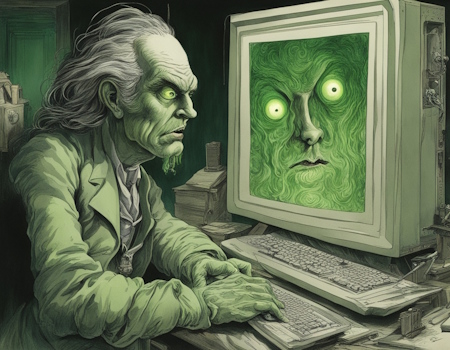
In literature the reader is encouraged to find meanings that the author did not intend, and I think images are the same way, and it's best to consider the making and the viewing as two separate events. AI cannot have the experience of making art. But if a person is looking at an image, they can totally have a "numinous, irreducible feeling" regardless of where the image came from. Otherwise you could reliably tell where it came from by looking for that feeling, and you can't.
Here's a quiz to tell the difference between human-made and AI-made images. This is often framed as AI vs "real", and this makes sense if AI is trying to fake a photograph. But human imaginative images are already unreal, and then the only question that matters is: Do you like it? I suggest taking the quiz with that question, "Do I like it?" instead of "Can I tell if this is AI so I know I'm not supposed to like it?" The key to navigating media in the age of AI is not counting fingers, it's taste. Only by exercising taste can you avoid being drowned in the rising sea of low-quality stuff, wherever it comes from.
I know there are social reasons to prefer human-made images to machine-made images, but those reasons are all because of capitalism and not technology. Under capitalism, it's important for artists to make money because you need money to not starve and die on the streets. If human artists are replaced with AI, those humans no longer deserve to live. In a more just system, humans replaced by machines would still get the money, but that's pretty complicated, so let's just declare the entire population to have already been replaced. With a guaranteed basic standard of living, people who want to do art can just do art -- or anything cheap that they enjoy doing. Whether or not machines can do it too, you can do your own thing and not have to try to wedge it into the cracks of commerce.
Back around to centaurs, a lot of human-made images are already in reverse centaur territory, where a human in a dreary office is required to make images that meet bland standards for mass distribution. I make videos like a regular centaur, by applying my inscrutable subjective taste to images that I outsource. I've done it with both human-made and AI-made images, and the process of pulling gems out of slop, and putting them in order, is exactly the same, and very satisfying. But with AI I get the additional fun of feedback, tweaking prompts to get the machine to do something I like.
Here's my latest video: Rex Holman - Red is the Apple. I picked the song because it's obscure and packed with evocative lines. I used lyrics for prompts when I could, and I thought I might crank it out in days, but it took more than two months to get it right.
]]>Another study took 2760 men and women in their 50s and put them through three tests -- grip strength, how many times they could go from sitting to standing in a minute and how long they could stand on one leg with their eyes closed. The single-leg stance test proved to be the most informative for their disease risk. Over the next 13 years, those able to stand on one leg for two seconds or less were three times more likely to have died than those who could do so for 10 seconds or more.
]]>As our technological society exhausts our resources and limps to a halt, we will revert back to an age of magic. The world of tomorrow will not be a world of wall-to-wall television and a spaceship in every garage. It will be a world of oracles.... Oneness with the cosmos would eliminate the need for money, for productivity, for an organized civilization. The whole population would become like the scattered few ascetics who sit entranced in caves, enjoying Godhead, total ecstatic unity with the superspectrum.
Modest individuals tend to view themselves as a single part of a larger world. They recognize the value and contributions of others and do not remain hyper-focused on their own status. The researchers hypothesized that this trait might allow for a "double win" in emotion regulation. They predicted that modest people would experience fewer negative emotions during rejection but would still experience strong positive emotions during acceptance.
One more from PsyPost: Data from 6 million couples reveals a surprising trend in how we pick our partners. Of course it's completely unsurprising. People are picking partners who share the same psychiatric diagnosis, because that's a big part of identity now.
Finally, a fascinating piece about mind-body practice, Meditation as Wakeful Relaxation: Unclenching Smooth Muscle. The idea is, your body has two kinds of muscles. Skeletal muscles are under conscious control, and are either tensed or relaxed. But smooth muscles are not under conscious control, and have a third state, called "latched", a kind of tensing that requires little or no energy:
Latches can persist for minutes, hours, days, months, or years, and the sum total of all latches likely accounts for the majority of bodily suffering. If you are "holding tension in your body" you are subject to the mechanics of the latch-bridge mechanism. Migraines and cluster headaches are almost certainly inappropriate VSMC latches; all hollow organs are surrounded by smooth muscle and can latch.
Long-term latching is still unproven, but the Hacker News thread has a lot of stuff about meditation techniques for deep relaxation. Personally, I get a lot of help from cannabis -- not that it automatically relaxes me, but if I lie down in silent darkness when I'm high, I discover that silent darkness is a zoo. There are all kinds of subtle things going on that become obvious. People say that drugs interfere with meditation, and it's true that it's harder for me to still my mind, but I'm a lot more motivated to try to still my mind, and a lot more aware of what's going on under the surface.
]]>]]>When a government collapses by force, power doesn't disappear; it breaks apart, security services fracture, criminal networks step forward, and armed insurgent groups fill gaps and wrap themselves in the language of liberation.... Removing Maduro doesn't automatically rebuild institutions, restore trust, or feed people. It creates a power vacuum in a country already hollowed out by corruption, sanctions, and scarcity.