Early Summer Odds and Ends -- 2 July 2010 -- For all the time I'm spending on the land, I'm not getting a whole lot done. Solo homesteading is really hard! Not only do I have to do work to water plants and dig holes -- I also have to do work to make the food to give myself the energy to do work, to move the solar oven around, to wash dishes, to freshen the water in the cooler, to brush the dirt out of the tent, to carry scraps to the compost bin. I don't even have to grow or hunt or forage the food I eat, and I'm already barely above the break-even point. It would be much easier if I was part of a small group, where one person could take care of cooking and cleaning for everyone... or if I had three stomachs and could just munch thimbleberry leaves all day to fuel myself.
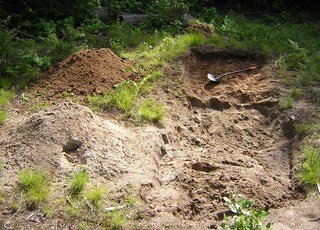
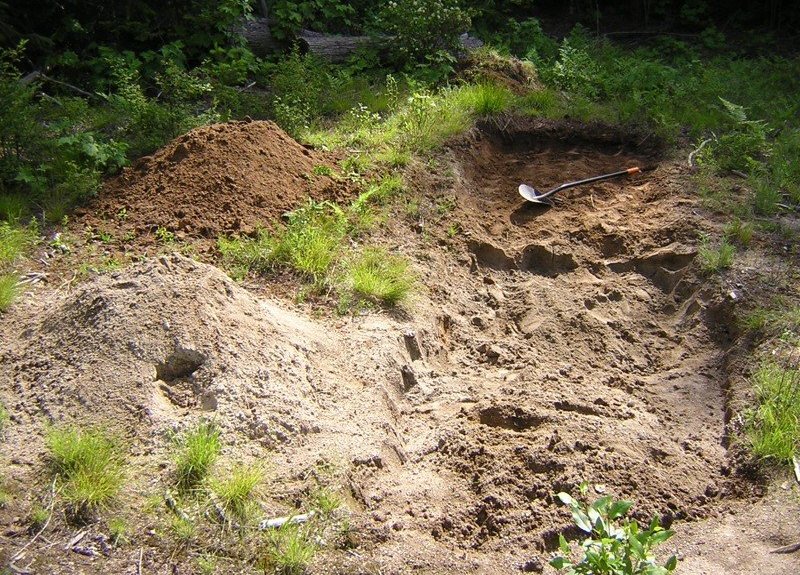
One thing I've discovered is that I love digging! In this picture you can see a pile of sand, a pile of brown silt, and in the background, a pile of topsoil. Later I made two more piles of sand and brown silt from digging a burning pit, a pile of red silt, and another huge pile of topsoil and good silty loam, from underneath where I've been throwing compost for five years.
Because of the rainy spring, all the native plants are growing extra this year. I spent a couple hours just trimming back the thimbleberry and snowberry and ocean spray and bracken ferns that are closing in above my trails and food plants. It seems like the bracken can grow a foot a day. Also I made a new trail, a cutoff from the tent to the outhouse. Between that and the ex-compost pit, I got so much oregon grape root, that soaking it all for tincture consumed an entire 1.75 liter bottle of vodka.
My plants are doing well, except the peach, which got leaf curl from the wet weather, and the black walnuts, which have always walked the edge of death. It turns out the late frost did damage the cherry blossoms -- the big tree is only going to make four cherries this year. The Orus 8 gooseberry/currant, and the Ivan's Belle, are both producing berries their first year. Both Ivan trees are putting on really impressive growth. One of the new paw paws is dead, and I transplanted another one that was in the way of a future project. Normally you can't transplant paw paws but the roots hadn't grown enough yet to be shocked.
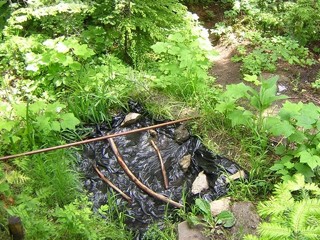
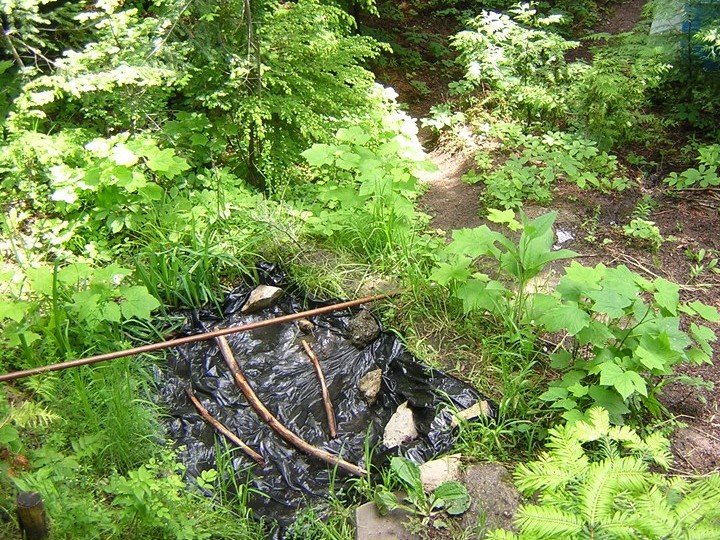
Another little project was to make an overflow pipe for the spring pool. Here you can see the new pipe suspended above the lower spring pool, which is now drained of water, and coated with horse manure and garbage bags. This is to create a "gley", a layer of anaerobically-decayed organic matter to stop water from leaking out. Until it's sealed, I've closed the new faucet, which drains from the bottom of the upper pool. So now the upper pool is overflowing, and the water is drizzling down the slope and soaking into the ground. I want to send the water down below the lower spring pool, to begin to create a stream course. So I picked out two ten foot copper pipes, a half inch (not shown) and a three quarter inch. The half inch pipe starts from the edge of the upper pool. It's held in place by nothing but the friction of having a foot of its length shallowly buried in dirt. Then the lower end of the half inch pipe fits inside the upper end of the three quarter inch pipe, and the lower end of that pipe rests on a rock to keep it from sliding down the hill, while the rigidity of the two pipes keeps them together. This is the sketchiest thing I've done up there that has actually worked.
The Faucet Job -- 16 June 2010 -- Back in May 2007 I did the
spring job, where I installed a copper pipe, catching the water where it comes up at the bottom of the spring pool, and carrying it 15 feet to come out of the hillside below. Since then, I've had a raw half inch pipe drizzling water constantly, down rocks into the lower pool. To fill drinking water containers, I would just set them on the rocks. The problem was, the flow would gradually decrease, probably because of the collector getting clogged with silt, and I would have to blow air through to clear it -- and then it would flow too fast and deplete the upper pool.
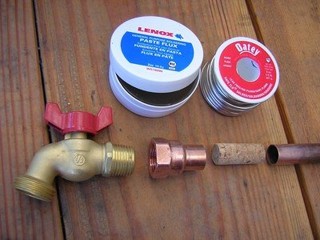
Here's the solution. The pipe in this photo is just for illustration -- the actual pipe is sticking out of the side of the hill. I sanded the cork down to fit in the pipe and stop the water flow. Above are the flux and lead-free solder for the joint. I could have soldered the faucet straight onto the pipe, but Charlie pointed out that the heat could damage the faucet, so instead I could solder on the intermediate copper piece and then screw the faucet on later.
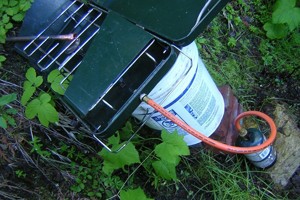
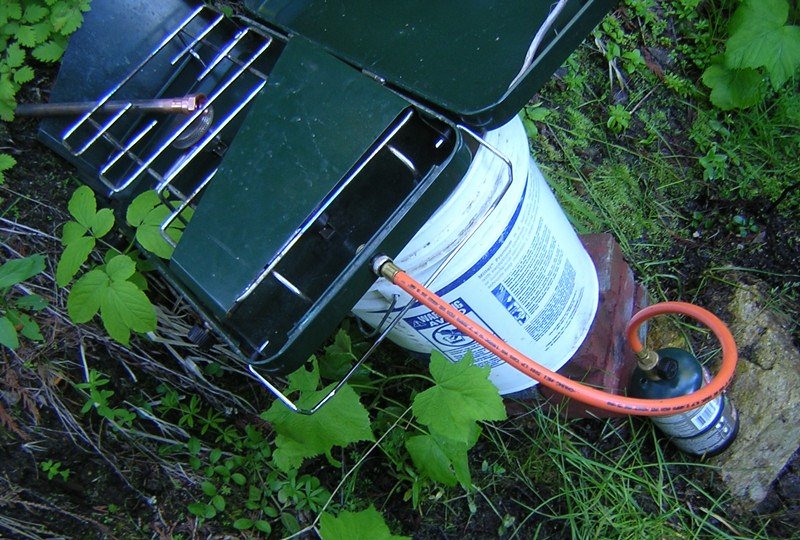
Another problem was that I didn't have a torch. So my plan was to plug the pipe with the cork, and then stack up bricks and a five gallon bucket to hold my two-burner propane camp stove right under the joint. Then after soldering the joint, I would use a drill to take the cork out. Can you guess where the plan went wrong?
It's surprisingly easy to solder a pipe with a camp stove, and surprisingly hard to get a cork out of a pipe with a drill bit. The cork fragments just got stuck deeper, and after all that work to avoid taking the pipe out of the hill, I had to take the pipe out of the hill. [Update: Chris writes that instead of a cork, you can use balled-up Wonder Bread! "It seals tight, but only temporarily."]
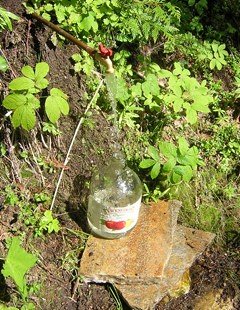
Luckily, the pipe segments under the ground were joined with an unsoldered coupling, so all I had to do was pull out the last five foot section, use two dried great mullein stalks to push the cork out, jam the pipe back in ground, and then dig a muddy hole to reconnect it. Obviously, I should have done that from the beginning.
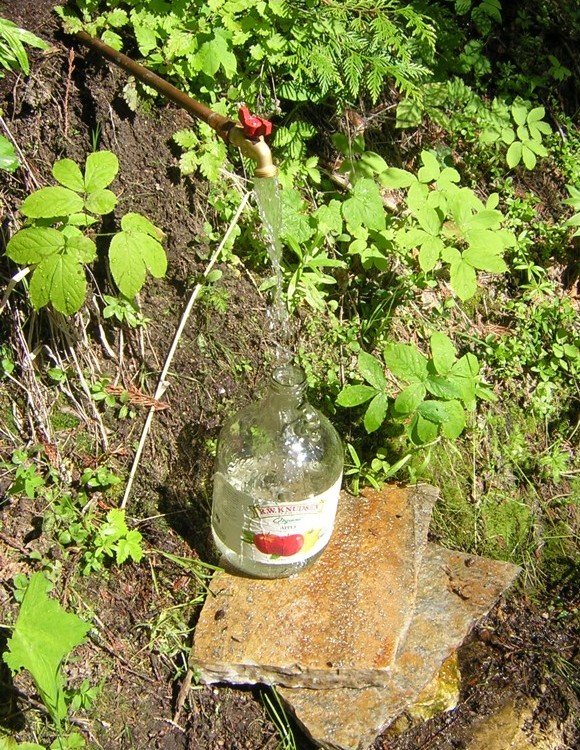
Anyway, you can see here that it works. Bob donated the rock slabs, which make it easier to fill containers. The only disadvantage is that the water splatters now instead of coming down in a smooth stream. But because I only use it when I need it, I can always have a fast flow (almost a gallon a minute) without draining the upper pool. And once I get the lower pool to hold water, I want to put in an overflow pipe from the top of the upper pool, to take the water straight to the lower pool instead of letting most of it soak into the ground.
 Tamping and Sawing -- 10 June 2010 --
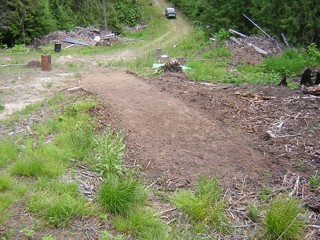
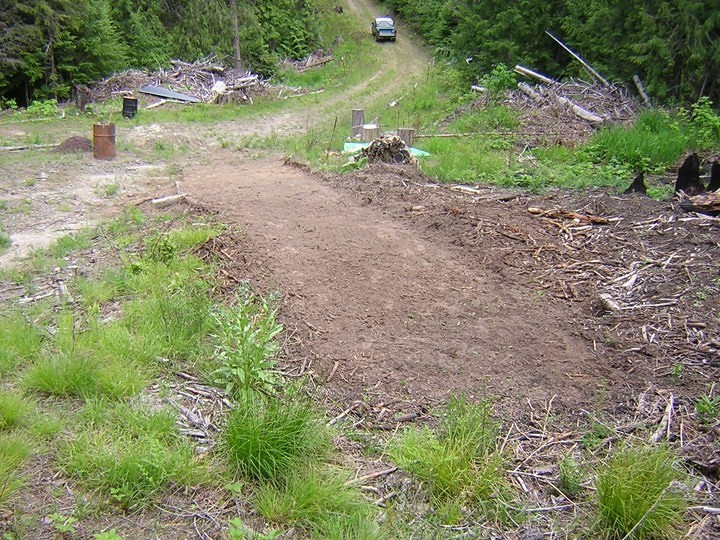
This was my big project on this trip, a vehicle ramp coming to the top of where the giant slash pile used to be. It took only an hour with a shovel to rough this out, and then several hours of raking and tamping to get it to this stage, and after this photo, I tried backing the truck to the top, and discovered that it still needs more tamping, since most of it is resting on fill. Bob donated a homemade tamper, a length of heavy pipe welded to a square foot of thick metal, but the weld is broken and it's barely holding together, so I'm mostly using myself as the tamper. I figure that I can stomp my own 145 pounds with more force than I can lift and push down a 50 pound object, although I can't spread it out as much. And then I can always drive the truck up and down.
Also I've started cutting down trees. A six inch diameter grand fir was just killed by some kind of critter that eats away under the bark. The needles at the top of the tree are red but haven't fallen off yet. Like a lot of the trees I'm cutting, it was stuck in other trees at the top, so after I cut it, it leaned a bit and I left it to fall on its own, and it came down in the rain the next morning.
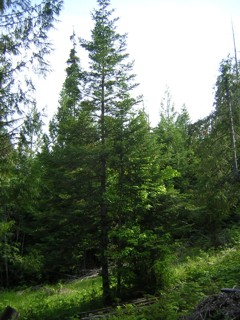
This healthy grand fir is marked for death, along with the small douglas fir just to its right. It makes me sad to kill a tree, but they're shading my apples, I can use the wood, and there are acres of other trees that I'm leaving alone. To the right of where I'm standing is one twice as thick and half again as tall, and by cutting it down this year I can avoid a more dangerous fall in the future.
I also spent a lot of time in the tent sketching on graph paper. Per my policy of not talking about certain things in advance, I'm not saying what I was sketching, or what the ramp is for. But plans are steadily creeping along, and with any luck I'll have something to show you before the internet goes down.
Digging -- 1 June 2010 -- I unloaded and checked out the straw bales, and they are inadequate for cob. The stalks are short and weak, and the edges are beginning to rot. I can still use them for compost or for standing on. So unless another source turns up, or some visitors really want to make cob, the cob project will have to be put off until July when they harvest the winter wheat. That's okay because there's plenty of other stuff I can do up there. On this trip, with all the rain, I did lots of digging.
I don't write about building plans anymore, but I can still write about what I'm not doing. I was thinking the north hill had bedrock close enough to the surface that I could build a cabin straight on the rock, and save the considerable trouble of assembling eight tons of rocks for a foundation. But a test hole got deeper and deeper and killed that plan. So far all the holes I've dug have been the same: one to six inches of topsoil, six to twelve inches of silt, and then sand as far as I can dig. That means, once I get through the silt, the digging is easy. It also explains why many plants don't like to grow up there. They would need both shallow roots to get nutrients from the topsoil, and deep roots to get water in the dry summers.
Anyway, this is the time to figure out every place that I might want to dig this year, and get through the silt while it's still soft. I figure I have a few more weeks.
Straw Season -- 28 May 2010 -- According to
The Hand-Sculpted House, the best straw for cob is oat, rye, or winter wheat, and I expect that winter wheat is the most common. Here's a page that shows planting and
harvest dates for wheat. In eastern Washington, winter wheat will not be harvested until July, which means if I want it in May, I have to buy bales stored since last summer. On Spokane Craigslist this month there are more people looking for straw than selling it, and I just drove nearly an hour each way to buy three mediocre bales for $5 each (plus $7.31 in gas money). I didn't even ask if it's spring or winter wheat, because at this point any straw is better than no straw. This is why I'm starting with a shed, so I can use up some mistakes on a structure that's not that important. And once the shed is done, I can use it to store summer bales over the winter.
Spring 2010 Roundup -- 26 May 2010 -- A couple weeks ago I bought three 55 gallon plastic water barrels off Craigslist for $25 each, which is not a great price, but good enough considering that they're at least $50 retail. I filled the white one with drinking water, and later I'll fill the blue ones with plant water. These are precautions in case the spring dries up after the mild winter.
I decided not to seal the tent edges to the platform. I got wood and screws to batten down the plastic sod cloth, but it turns out that the two long sides of the platform are uneven because of varying wood lengths, and since mosquitoes are only aggressive all night for a few weeks a year, no technique is worth the trouble.
So on the latest trip, still lacking straw for cob, I did what I like to do best: puttered around taking care of little things. First I checked out all the plants. Last weekend we had a late frost, and I was worried that even some natives might be damaged, but I found shriveled leaves on only two plants, a black walnut and an American chestnut -- the other chestnut and walnuts hadn't leafed out yet. The cherry blossoms had brown spots but should still make cherries.
Blossoming for the first time this year were one Nanking cherry, the youngest Aronia, and the Ivan's Belle that I just planted, or maybe the Ivan's Beauty, I forget which. Ivan Michurin was a legendary Russian plant breeder, and those are two crosses he made with European mountain ash, a.k.a.
Rowan, and according to the Wikipedia article at that link, it's also called a Ran tree! Anyway, one crosses hawthorne and one crosses aronia, and both of them are looking great, although they have yet to be tested by the hot dry summer. Two of last year's sea buckthorns are dead, an Orange September female and the male, and also one of last year's walnuts. Most everything else is just squeaking by as usual. The Ashmead's apple is putting on some nice growth in its second spring after being broken to the ground on two consecutive winters.
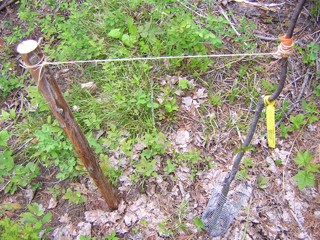
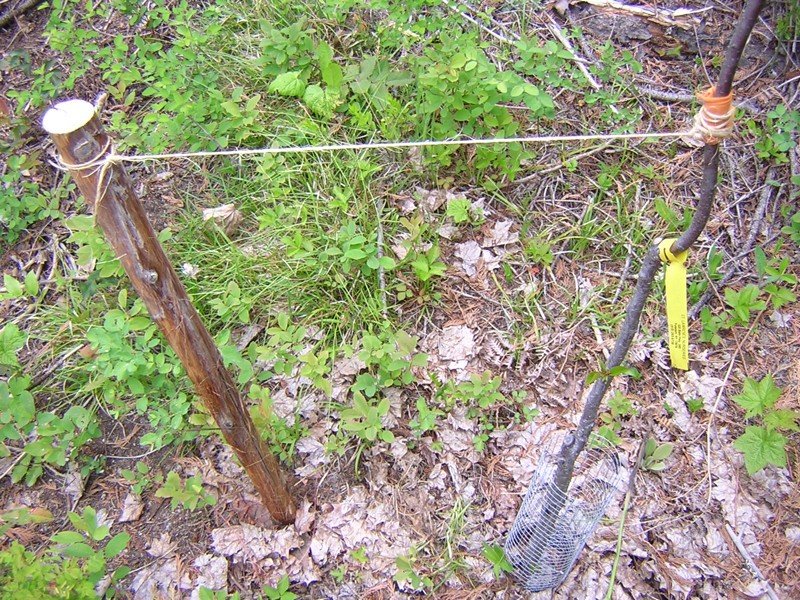
All four cherries, and no other plants, are now tied to stakes to make them stand up straight. That's not so strange when you consider that most of my other plants are either bushes, or tree species that keep dying or having to resprout from the base. Anyway, there's a lot going on in this picture. On the left is my best cedar stake. I pounded it in deep because this tree needed to be bent with about five pounds of tension, which is also why I tied the cloth around it. Below that you can see that I cut a branch off. The one growing straight up was much smaller than the one going out to the side, and they were too close together with a weak crotch, so after trying and failing to clone the central one into a new tree with a rooter pot, I cut it off. Luckily the side branch and the trunk below it were leaning the same way.
And my big project on this trip was trying to get the lower spring pool to hold water. It used to hold it fine, but I must have dug down too far because all the water started leaking out the bottom. I tried coating it with clay, and then throwing a bag of leaves in, which just made it smell like a sewer. Then I saw a Sepp Holzer video on exactly the same subject, and I sat through ten minutes of rambling to get the half minute point: He watched pigs seal ponds, experimented to imitate them, and discovered that the trick is lots of wet tamping. So I added more clay and silt, and tamped it in hard with my bare feet and a small log. It's better now but still needs work. I also think the pigs add manure which creates a biological membrane called a
gley. That's a forum thread about the technique. Because my pool is small, the rotting leaves might be enough. If not, I'll wait for July and rot a layer of manure under plastic.
Weeds -- 21 May 2010 -- Here's an excellent Sharon Astyk post,
Getting Intimate With My Weeds. She covers which ones are so good that we should plant them, how we can use them to learn about the land, and how "invasives" are mostly symptoms of human mismanagement. On my land I've noticed that both spotted knapweed and hound's tongue produce lots of nectar for the wild bees, so I only pluck the knapweed if it's growing next to something important, and I kill the hound's tongue after it flowers but before it finishes making seeds, which are terrible burrs. I've also scattered seedballs and plain seeds of dandelion, lamb's quarters, and chickweed, but none of them like to grow up there.
Archives:
September - October 2004
November - December 2004
January - March 2005
March - April 2005
May - July 2005
August 2005
September - October 2005
January - April 2006
May - June 2006
August 2006
September - November 2006
April - May 2007
June - September 2007
April - June 2008
July - November 2008
January - April 2009
May - June 2009
July - August 2009
September - November 2009
January - April 2010

 One thing I've discovered is that I love digging! In this picture you can see a pile of sand, a pile of brown silt, and in the background, a pile of topsoil. Later I made two more piles of sand and brown silt from digging a burning pit, a pile of red silt, and another huge pile of topsoil and good silty loam, from underneath where I've been throwing compost for five years.
 Another little project was to make an overflow pipe for the spring pool. Here you can see the new pipe suspended above the lower spring pool, which is now drained of water, and coated with horse manure and garbage bags. This is to create a "gley", a layer of anaerobically-decayed organic matter to stop water from leaking out. Until it's sealed, I've closed the new faucet, which drains from the bottom of the upper pool. So now the upper pool is overflowing, and the water is drizzling down the slope and soaking into the ground. I want to send the water down below the lower spring pool, to begin to create a stream course. So I picked out two ten foot copper pipes, a half inch (not shown) and a three quarter inch. The half inch pipe starts from the edge of the upper pool. It's held in place by nothing but the friction of having a foot of its length shallowly buried in dirt. Then the lower end of the half inch pipe fits inside the upper end of the three quarter inch pipe, and the lower end of that pipe rests on a rock to keep it from sliding down the hill, while the rigidity of the two pipes keeps them together. This is the sketchiest thing I've done up there that has actually worked.
  Another problem was that I didn't have a torch. So my plan was to plug the pipe with the cork, and then stack up bricks and a five gallon bucket to hold my two-burner propane camp stove right under the joint. Then after soldering the joint, I would use a drill to take the cork out. Can you guess where the plan went wrong?
 Luckily, the pipe segments under the ground were joined with an unsoldered coupling, so all I had to do was pull out the last five foot section, use two dried great mullein stalks to push the cork out, jam the pipe back in ground, and then dig a muddy hole to reconnect it. Obviously, I should have done that from the beginning.
 Tamping and Sawing -- 10 June 2010 --
This was my big project on this trip, a vehicle ramp coming to the top of where the giant slash pile used to be. It took only an hour with a shovel to rough this out, and then several hours of raking and tamping to get it to this stage, and after this photo, I tried backing the truck to the top, and discovered that it still needs more tamping, since most of it is resting on fill. Bob donated a homemade tamper, a length of heavy pipe welded to a square foot of thick metal, but the weld is broken and it's barely holding together, so I'm mostly using myself as the tamper. I figure that I can stomp my own 145 pounds with more force than I can lift and push down a 50 pound object, although I can't spread it out as much. And then I can always drive the truck up and down.
Tamping and Sawing -- 10 June 2010 --
This was my big project on this trip, a vehicle ramp coming to the top of where the giant slash pile used to be. It took only an hour with a shovel to rough this out, and then several hours of raking and tamping to get it to this stage, and after this photo, I tried backing the truck to the top, and discovered that it still needs more tamping, since most of it is resting on fill. Bob donated a homemade tamper, a length of heavy pipe welded to a square foot of thick metal, but the weld is broken and it's barely holding together, so I'm mostly using myself as the tamper. I figure that I can stomp my own 145 pounds with more force than I can lift and push down a 50 pound object, although I can't spread it out as much. And then I can always drive the truck up and down.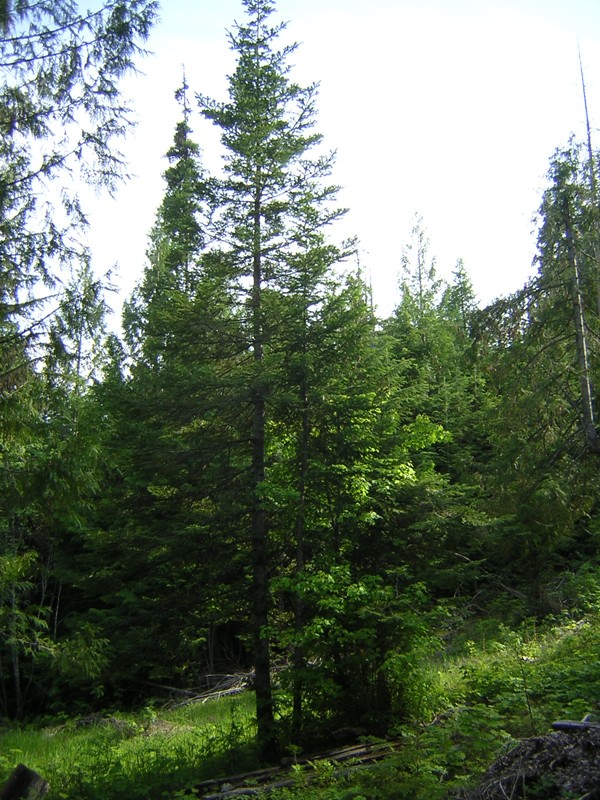 This healthy grand fir is marked for death, along with the small douglas fir just to its right. It makes me sad to kill a tree, but they're shading my apples, I can use the wood, and there are acres of other trees that I'm leaving alone. To the right of where I'm standing is one twice as thick and half again as tall, and by cutting it down this year I can avoid a more dangerous fall in the future.
 All four cherries, and no other plants, are now tied to stakes to make them stand up straight. That's not so strange when you consider that most of my other plants are either bushes, or tree species that keep dying or having to resprout from the base. Anyway, there's a lot going on in this picture. On the left is my best cedar stake. I pounded it in deep because this tree needed to be bent with about five pounds of tension, which is also why I tied the cloth around it. Below that you can see that I cut a branch off. The one growing straight up was much smaller than the one going out to the side, and they were too close together with a weak crotch, so after trying and failing to clone the central one into a new tree with a rooter pot, I cut it off. Luckily the side branch and the trunk below it were leaning the same way.