Digging -- 1 June 2010 -- I unloaded and checked out the straw bales, and they are inadequate for cob. The stalks are short and weak, and the edges are beginning to rot. I can still use them for compost or for standing on. So unless another source turns up, or some visitors really want to make cob, the cob project will have to be put off until July when they harvest the winter wheat. That's okay because there's plenty of other stuff I can do up there. On this trip, with all the rain, I did lots of digging.
I don't write about building plans anymore, but I can still write about what I'm not doing. I was thinking the north hill had bedrock close enough to the surface that I could build a cabin straight on the rock, and save the considerable trouble of assembling eight tons of rocks for a foundation. But a test hole got deeper and deeper and killed that plan. So far all the holes I've dug have been the same: one to six inches of topsoil, six to twelve inches of silt, and then sand as far as I can dig. That means, once I get through the silt, the digging is easy. It also explains why many plants don't like to grow up there. They would need both shallow roots to get nutrients from the topsoil, and deep roots to get water in the dry summers.
Anyway, this is the time to figure out every place that I might want to dig this year, and get through the silt while it's still soft. I figure I have a few more weeks.
Straw Season -- 28 May 2010 -- According to
The Hand-Sculpted House, the best straw for cob is oat, rye, or winter wheat, and I expect that winter wheat is the most common. Here's a page that shows planting and
harvest dates for wheat. In eastern Washington, winter wheat will not be harvested until July, which means if I want it in May, I have to buy bales stored since last summer. On Spokane Craigslist this month there are more people looking for straw than selling it, and I just drove nearly an hour each way to buy three mediocre bales for $5 each (plus $7.31 in gas money). I didn't even ask if it's spring or winter wheat, because at this point any straw is better than no straw. This is why I'm starting with a shed, so I can use up some mistakes on a structure that's not that important. And once the shed is done, I can use it to store summer bales over the winter.
Spring 2010 Roundup -- 26 May 2010 -- A couple weeks ago I bought three 55 gallon plastic water barrels off Craigslist for $25 each, which is not a great price, but good enough considering that they're at least $50 retail. I filled the white one with drinking water, and later I'll fill the blue ones with plant water. These are precautions in case the spring dries up after the mild winter.
I decided not to seal the tent edges to the platform. I got wood and screws to batten down the plastic sod cloth, but it turns out that the two long sides of the platform are uneven because of varying wood lengths, and since mosquitoes are only aggressive all night for a few weeks a year, no technique is worth the trouble.
So on the latest trip, still lacking straw for cob, I did what I like to do best: puttered around taking care of little things. First I checked out all the plants. Last weekend we had a late frost, and I was worried that even some natives might be damaged, but I found shriveled leaves on only two plants, a black walnut and an American chestnut -- the other chestnut and walnuts hadn't leafed out yet. The cherry blossoms had brown spots but should still make cherries.
Blossoming for the first time this year were one Nanking cherry, the youngest Aronia, and the Ivan's Belle that I just planted, or maybe the Ivan's Beauty, I forget which. Ivan Michurin was a legendary Russian plant breeder, and those are two crosses he made with European mountain ash, a.k.a.
Rowan, and according to the Wikipedia article at that link, it's also called a Ran tree! Anyway, one crosses hawthorne and one crosses aronia, and both of them are looking great, although they have yet to be tested by the hot dry summer. Two of last year's sea buckthorns are dead, an Orange September female and the male, and also one of last year's walnuts. Most everything else is just squeaking by as usual. The Ashmead's apple is putting on some nice growth in its second spring after being broken to the ground on two consecutive winters.
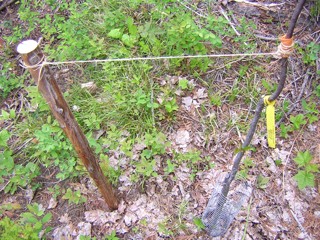
All four cherries, and no other plants, are now tied to stakes to make them stand up straight. That's not so strange when you consider that most of my other plants are either bushes, or tree species that keep dying or having to resprout from the base. Anyway, there's a lot going on in this picture. On the left is my best cedar stake. I pounded it in deep because this tree needed to be bent with about five pounds of tension, which is also why I tied the cloth around it. Below that you can see that I cut a branch off. The one growing straight up was much smaller than the one going out to the side, and they were too close together with a weak crotch, so after trying and failing to clone the central one into a new tree with a rooter pot, I cut it off. Luckily the side branch and the trunk below it were leaning the same way.
And my big project on this trip was trying to get the lower spring pool to hold water. It used to hold it fine, but I must have dug down too far because all the water started leaking out the bottom. I tried coating it with clay, and then throwing a bag of leaves in, which just made it smell like a sewer. Then I saw a Sepp Holzer video on exactly the same subject, and I sat through ten minutes of rambling to get the half minute point: He watched pigs seal ponds, experimented to imitate them, and discovered that the trick is lots of wet tamping. So I added more clay and silt, and tamped it in hard with my bare feet and a small log. It's better now but still needs work. I also think the pigs add manure which creates a biological membrane called a
gley. That's a forum thread about the technique. Because my pool is small, the rotting leaves might be enough. If not, I'll wait for July and rot a layer of manure under plastic.
Archives:
September - October 2004
November - December 2004
January - March 2005
March - April 2005
May - July 2005
August 2005
September - October 2005
January - April 2006
May - June 2006
August 2006
September - November 2006
April - May 2007
June - September 2007
April - June 2008
July - November 2008
January - April 2009
May - June 2009
July - August 2009
September - November 2009
January - April 2010

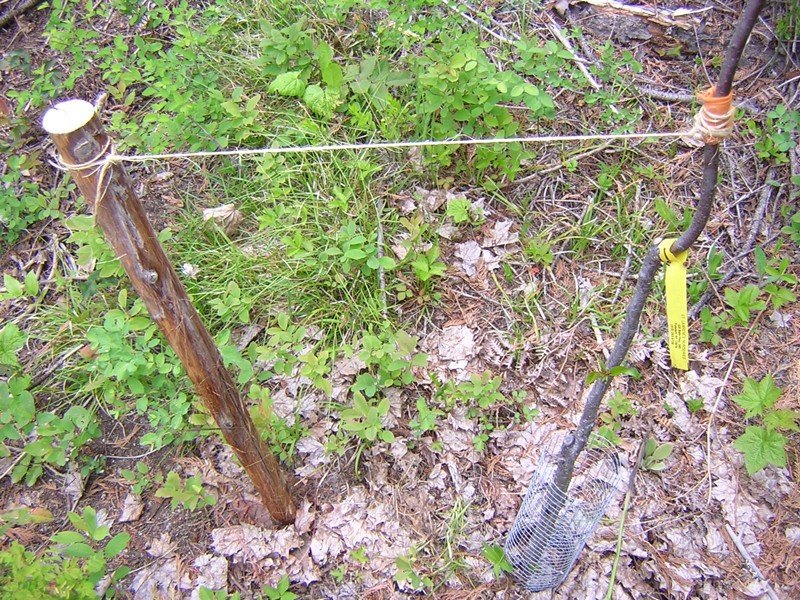 All four cherries, and no other plants, are now tied to stakes to make them stand up straight. That's not so strange when you consider that most of my other plants are either bushes, or tree species that keep dying or having to resprout from the base. Anyway, there's a lot going on in this picture. On the left is my best cedar stake. I pounded it in deep because this tree needed to be bent with about five pounds of tension, which is also why I tied the cloth around it. Below that you can see that I cut a branch off. The one growing straight up was much smaller than the one going out to the side, and they were too close together with a weak crotch, so after trying and failing to clone the central one into a new tree with a rooter pot, I cut it off. Luckily the side branch and the trunk below it were leaning the same way.