
"Self-sufficiency means that one does not have to extort ecological fertility from the earth in order to trade with the empire for baubles."
- William Kötke
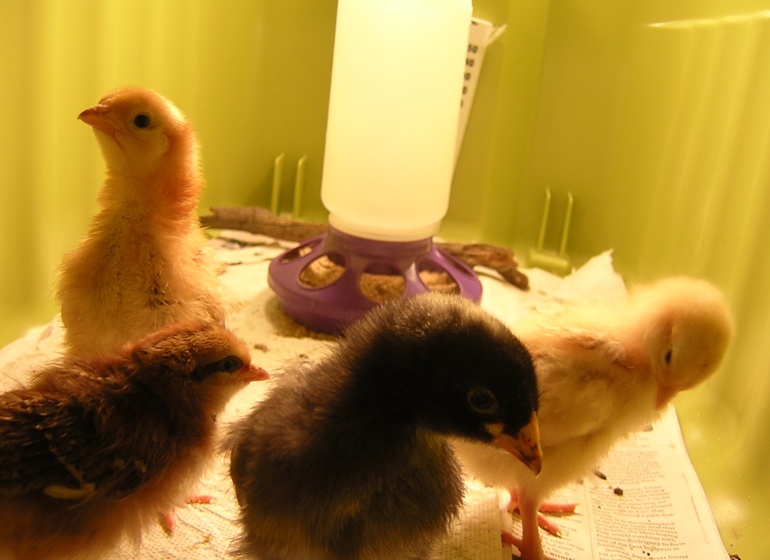 Chicks -- 14 March 2010 -- It will be a few years before I'm in a position to get chickens, but these are the chicks that my sister and brother-in-law just got in Seattle. They're about two weeks old, all hens. The one stretching on the left is a Rhode Island Red, below it is a Speckled Sussex, the black one is a Barred Rock, and on the right is a Buff Orpington. By watching them (we call it Chick TV) I'm already learning their personalities. The Orpington is just very mellow; the Rock has emerged as the alpha and the tough one; the Sussex is the smallest and wildest; and the Red is not too bright. Today my sister gave them two feedings of earthworms from the back yard, and the Red did not get a single one. She barely recognized the worms as food, pecked at them a bit, and then chased around the other chicks. The Rock chased around the other chicks and took their worms, while the Sussex immediately recognized the worms as food, grabbed them and ran away fast.
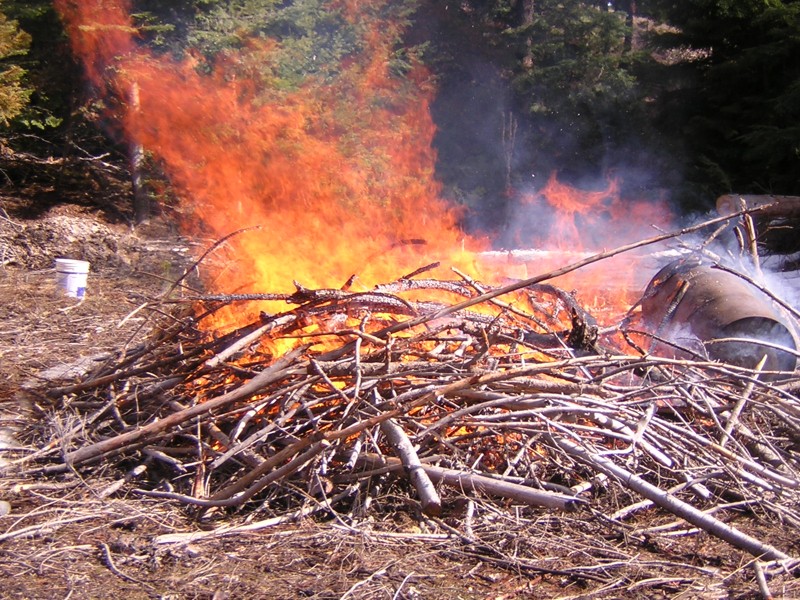 Slash Burn 2010 -- 25 February 2010 -- If you've never set fire to a pile of dry branches the size of a large car, I recommend it. This is the scariest picture I took, and it still doesn't look like much, and it's nothing compared to a forest fire, but even a fire this size is scary! It's surprisingly loud, hot, and violent. This is mostly the limbs of the two western hemlocks that fell a couple years ago. You can see the pile on the right side of this photo from last June. I covered it with a tarp over the winter to keep it dry, and stuck in a barrel that needed to be burned clean. Two days ago I drove up early, walked in the last mile, and lit it up with a rag soaked in alcohol. That fire went out! So I lit another fire, and then another. You really have to build a small campfire inside the pile. But then at a certain point, it takes off fast.
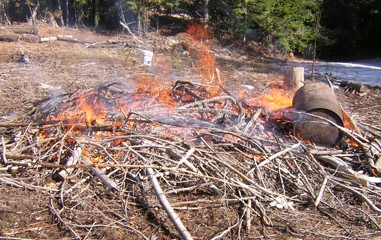 If you're doing this in cold, damp weather, as you should, the wood at the edges of the pile will not burn. Maybe 20 minutes after the above photo, you can see here that the fire has gone down and has just eaten out the center of the pile. About ten minutes after this, it finally cooled down enough that I could get close enough to throw most of the edge wood into the center with a shovel. In this photo and the above, you can see a five gallon bucket full of water, one of three that I set around the perimeter in case the fire spread, which turned out to be completely unnecessary this early in the year.
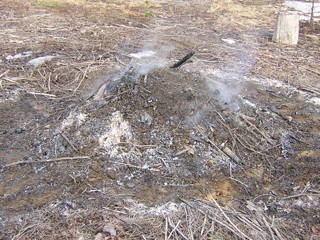 When all the wood was burned, turned to charcoal, or on fire, I got the idea to bury what was left so that more of it would turn into charcoal instead of burning. So I just went around the edges with a shovel and threw all the coals and the dirt under them into a pile in the center. I figure I'll pick out all the charcoal and store it for terra preta, and use this same spot every year for slash burning. Between that and the five or six piles that I've covered with leaves to speed decomposition, I think I'm gradually gaining on the dead wood.
Archives:
September - October 2004
November - December 2004
January - March 2005
March - April 2005
May - July 2005
August 2005
September - October 2005
January - April 2006
May - June 2006
August 2006
September - November 2006
April - May 2007
June - September 2007
April - June 2008
July - November 2008
January - April 2009
May - June 2009
July - August 2009
September - November 2009